

French Press vs Drip Coffee: Which One Should You Use?
Drip machine or French press: the cup, the effort, the cost and the honest trade-offs compared, plus a clear recommendation for each kind of home brewer.

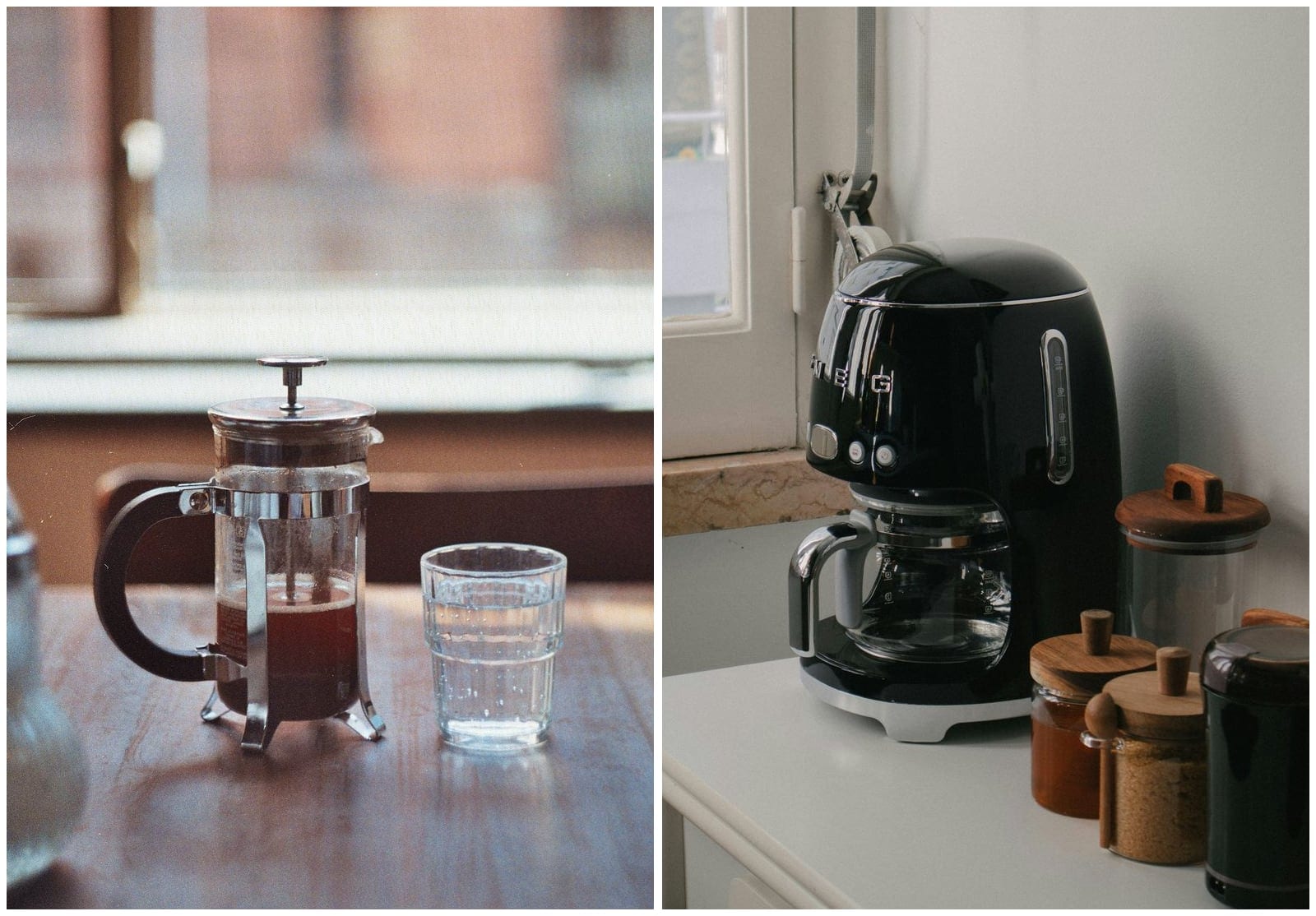
The same beans can go into either one. The filter is what makes the two cups different. · Photos by Ilinca Roman, and Nubelson Fernandes on Unsplash
A drip machine brews hands-off and keeps coffee warm, which is why it owns most kitchens. A French press brews by full immersion through a metal filter, so the cup has more body and keeps the oils paper strips out. Drip is the one to own if you need four mugs on a weekday and don't want to think about it. A press gives you a better cup for less money, as long as you're willing to come back for it after four minutes. If you brew for three or more people every morning, keep the drip machine. If you're coming off a cheap one and you've never tried anything else, a $30 press will change more about your coffee than anything else you can buy at that price.
I grew up in Rio, where coffee was never really about the coffee. It was the excuse to sit down and stay longer. When I moved to Amsterdam I kept that up with friends and shortbread and afternoons that ran long, and I've been fussy about the coffee ever since.
These two don't get used at the same hour. A drip machine is for weekday mornings, before anyone is properly awake. A press is for the afternoon, when there are people at the table and nobody is in a hurry.
What actually separates these two methods?
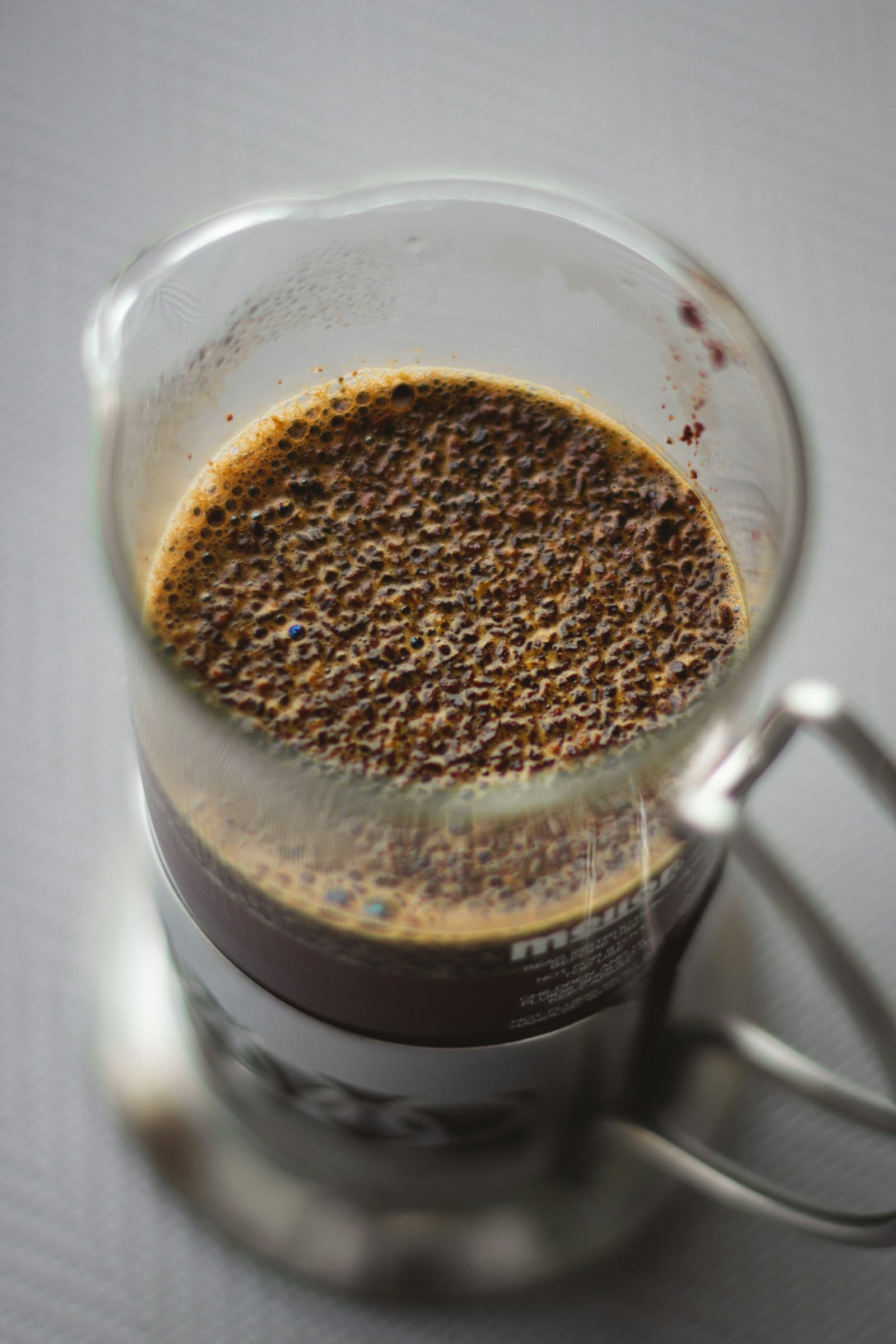
The difference between drip and French press isn't the machine or the price. It's the filter, and what the filter keeps out of your cup.
A drip coffee maker passes hot water through a paper filter packed with ground coffee. Paper catches the coffee's natural oils and the finest ground particles, called fines. What lands in the carafe is a clean, lighter-bodied cup where the individual flavors of the bean come through clearly. That clarity is the drip machine's best quality. It's also why a cheap drip machine tastes thin, because there's very little body in the cup to carry the flavor.
A French press uses a metal mesh plunger instead. When you press and pour, the mesh holds back the coarse grounds and lets the oils and some fines through. The cup is heavier and fuller, with a texture in the mouth that paper-filtered coffee can't produce. There's also a fine layer of sediment at the bottom of every French press cup, which some people love and others can't get past.
That difference isn't only about flavor, and it's worth knowing before you switch. The oils carry two compounds, cafestol and kahweol, and paper is what catches them. A 2025 Swedish analysis measured 86.8 mg/L of cafestol in French press coffee against a median of 11.5 mg/L in paper-filtered drip, roughly seven times as much (Orrje et al., Nutrition, Metabolism and Cardiovascular Diseases, 2025, reported by Healio). A Norwegian study that followed 508,747 adults for around twenty years found lower mortality among filtered-coffee drinkers than among unfiltered (European Society of Cardiology press release). Professor Dag Thelle of the University of Gothenburg, who ran it, put the mechanism plainly: "Using a filter removes these and makes heart attacks and premature death less likely." For most people that's a footnote. If your cholesterol is already high, it's worth weighing against the flavor.
Flavor, cleanup and which beans each one suits all follow from that difference. If you want the mechanism underneath it, what coffee extraction actually is covers what the water is pulling out of the grounds in both cases.
When drip earns its place
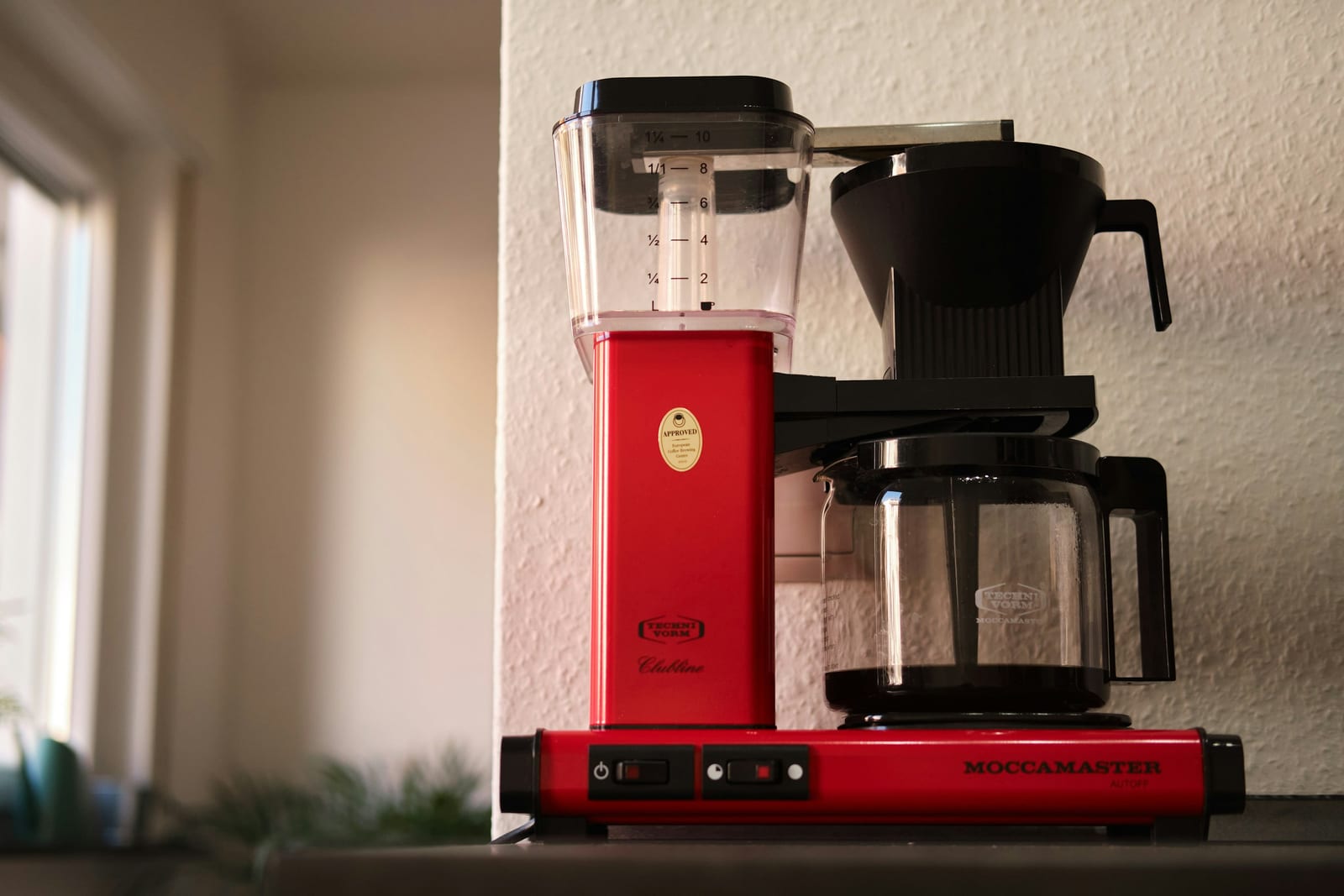
The drip machine has been the most common home brewer for decades, and it earned that. It asks almost nothing of you. You fill the reservoir, add ground coffee to the paper filter basket, press a button and walk away. Ten minutes later there's hot coffee. If your machine has a heating plate under the carafe, it stays warm for another hour or two. If it has a timer, you can set it the night before and wake up to a full pot.
That hands-off quality matters more than people admit when they're comparing coffee gear. Most specialty coffee advice is written for people who genuinely want to think about coffee in the morning. Plenty of people don't. They want it done before they're fully awake. A drip machine is the right answer for them, and I'd tell them so.
Drip machines also scale easily. A 12-cup machine holds 60 fl oz, about 1.8 liters, because the "cup" on a drip machine is a five-ounce cup rather than a mug. That's four or five real mugs. A French press maxes out around 1 liter on the largest models, and the steep and the plunge don't parallelize when you have guests waiting.
Where drip machines vary most is how precisely they hit the target temperature. Good extraction wants water between 90°C (194°F) and 96°C (205°F). The Specialty Coffee Association sets a stricter bar before it will certify a home brewer: the machine has to "reach 92 °C within the first minute" of the brew, hold at least that for the rest of the cycle, and never exceed 96 (SCA certification requirement, quoted in Batali, Ristenpart and Guinard, Scientific Reports, 2020). Most machines on a shop shelf aren't certified, so nobody has actually checked what yours brews at. If your drip coffee disappoints you, look hard at the machine before you blame the method. Certified brewers (the Technivorm Moccamaster, the Breville Precision Brewer and a handful of others) hit the temperature reliably. They run $150 to $350, a real gap next to a French press.
Two costs come with all that convenience. Paper filters are a recurring purchase, and running out means a trip to the shop. And a heating plate under a glass carafe keeps coffee warm by carrying on cooking it, which flattens a good cup and turns it bitter. I can't give you a number of minutes for that, because it depends on the plate, the carafe and how much is left sitting in it. A thermal carafe solves the problem outright, and most decent machines now use one.
When French press is the right call
The French press is one of the oldest manual methods still in common use. The design, a glass or steel cylinder with a plunger and a metal mesh filter, hasn't changed meaningfully since the mid-twentieth century, because it doesn't need to. It brews by full immersion: coarse grounds, hot water, a wait, a press, a pour.
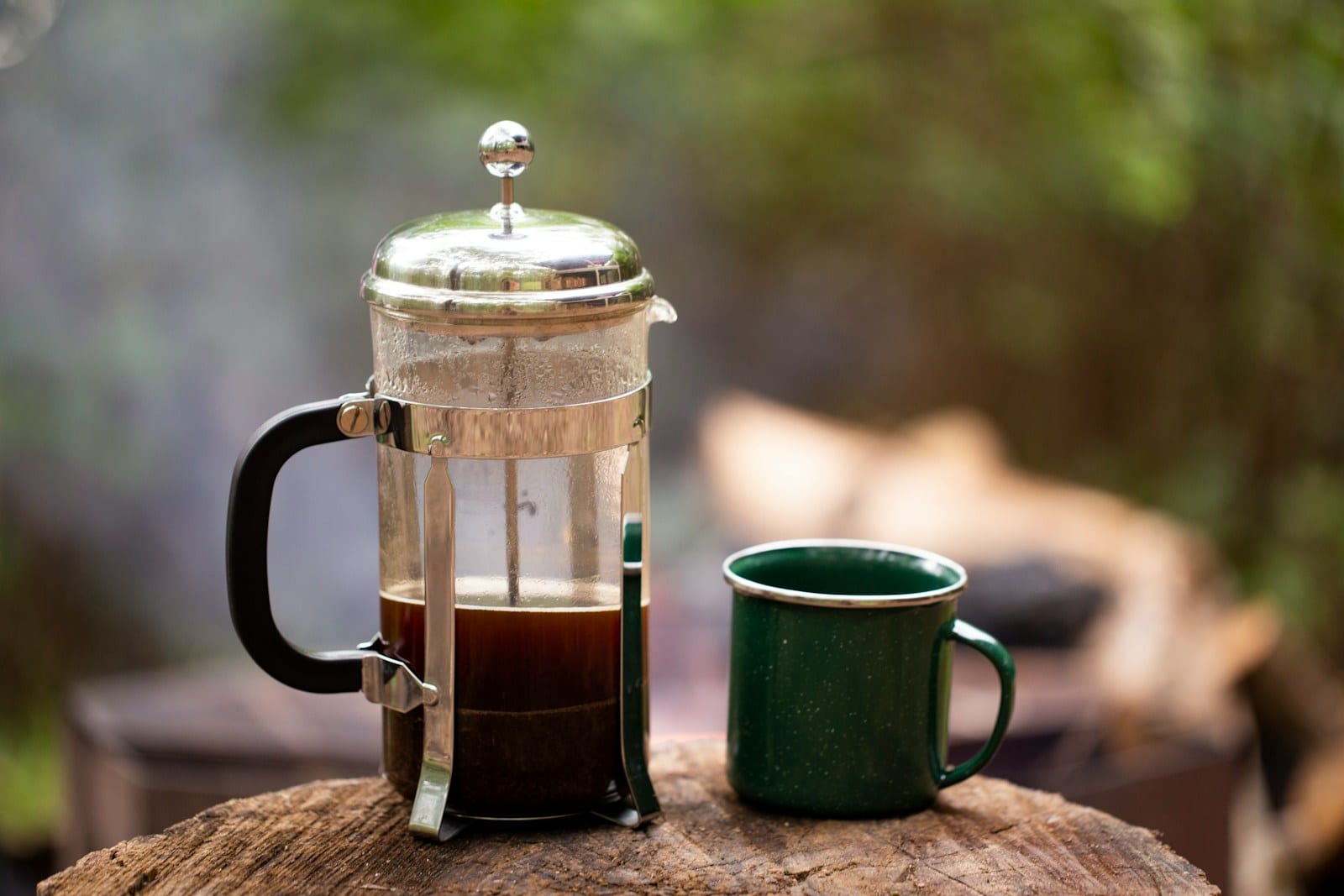
The cup is unlike anything paper-filtered. The oils a drip machine strips out stay in the brew, and they're responsible for most of what people mean when they say coffee tastes rich or full. Dark roasts benefit the most. The body softens the rougher, more astringent edges they carry, and the same beans come out warmer and rounder than they do from a drip machine.
The starting recipe is simple. Coarse grind, close to coarse sea salt. A 1:15 ratio is a good baseline: 30g (1.06oz) of coffee to 450ml (15.2 fl oz) of water at 90°C (194°F) to 96°C (205°F). Stir once the grounds are wet, then leave it alone.
When the brew is done, get the coffee off the grounds. Immersion doesn't stop on its own, so whatever stays in the carafe keeps extracting and turns bitter in a way no later adjustment fixes. Press, then pour every drop out, into cups or into a warmed carafe. A drip machine stops by itself. A French press stops when you stop it.
Four minutes is the standard steep and it's where I'd start. Some techniques deliberately take longer before the press, and that's fine. Our French press house recipe stirs, skims the crust off the top and lets the cup settle for a minute before you press. James Hoffmann's published French press technique builds in a longer settle before a gentle pour (Hoffmann, "The Ultimate French Press Technique"). Both are built around the settle, and both still pour everything out at the end.
The honest costs are sediment and cleanup. Even a well-made French press leaves a thin layer of fines at the bottom of the cup; most people stop noticing within a week, and some never make peace with it. Cleanup is the worst of any common manual method. Wet grounds have to come out of the carafe, the mesh unscrews and needs rinsing, and the oils leave a film on the glass that wants a real wash rather than a rinse.
How do these methods compare side by side?
Prices below are US dollars, and assume decent gear rather than premium.
| What you are comparing | Drip machine | French press |
|---|---|---|
| Brew time | 8 to 12 minutes | 4 minutes active, longer if you settle |
| Hands-on effort | Very low. Fill, press, walk away. | Low, but you have to come back for it. |
| Cup style | Clean, lighter body, clear flavors | Full-bodied, oily, heavier texture |
| Grind | Medium | Coarse, like sea salt |
| Best for | Dark to medium roasts, volume, convenience | Any roast; dark roasts especially |
| Volume | 8 to 12 cups per cycle | 2 to 4 cups per press |
| Portability | None | Low. Glass breaks; no lid seal. |
| Cleanup | Easy. Toss paper filter. | Annoying. Wet grounds, oily mesh. |
| Sediment in cup | None | Yes. Fine layer at the bottom. |
| Diterpenes (cafestol) | Around 12 mg/L | Around 87 mg/L |
| Entry cost | $25 to $350 depending on quality | $25 to $60 |
| Recurring cost | Paper filters | None |
Which should you pick?
If you brew for three or more people every morning and you can't stand at the counter: keep or buy a quality drip machine. The volume and the hands-off process are the whole point. If your current machine is cheap, upgrading to a certified brewer does more for your cup than switching methods will.
If you're one person or a household of two: a French press almost certainly makes more sense. The volume is right, the cost is lower, and the cup is better as long as the beans are decent. The only thing you give up is the freedom to ignore the timer.
If you're coming off a cheap drip machine: try a French press before spending $200 on a better drip brewer. A $30 press and a bag of coarse-ground coffee will show you what your current machine has been hiding. If you love the result, the method suits you. If you miss the cleaner style, you've learned that too, and you can buy a better drip machine knowing exactly why.
If you care about tasting the bean and you buy single-origin or light roasts: a French press won't show you origin character the way a pour over does, because the oils and the body sit over some of the finer flavors. For light and medium single-origins, a pour over or an AeroPress serves you better (pour over vs French press vs AeroPress compares all three). Drip on a certified machine is a close second.
If you want the best dark roast you've ever made at home: make it in a French press. Nothing flatters a dark roast like immersion through a metal filter. Our French press house recipe runs 30g (1.06oz) of coffee and 450ml (15.2 fl oz) of water at 94°C (201°F), coarse grind, 1:15 ratio, with a stir, a skim and a one-minute settle before you press, which keeps the cup cleaner than a straight plunge.
If you want iced coffee: the French press is more useful here than a drip machine, because you can steep a concentrate in it and get cold brew out the other end. Our house recipe runs 200g (7.05oz) of coffee to 1000ml (33.8 fl oz) of water at 20°C (68°F), a 1:5 ratio, steeped around 20 hours and diluted 1:1 to serve. A drip machine needs separate gear for the same job. If you want iced coffee fast and you already own a pour over, Japanese iced coffee brewed straight onto ice beats both.
What gear do you actually need?
For drip: the machine is the main cost, from $25 for a basic Mr. Coffee to $350 for a Technivorm Moccamaster or a Breville Precision Brewer. Paper filters are cheap and sold everywhere. A burr grinder matters more than any other accessory, because a blade grinder produces an uneven particle distribution that breaks extraction no matter how good the machine is. A basic manual burr grinder starts at $40 to $60. An entry-level electric one runs $150 to $200.
For French press: the press itself costs $25 to $60. Bodum sits at the cheap end of that range and Frieling at the expensive one. Any kettle works, since there's no pour technique to speak of. A kitchen scale at $15 to $25 is worth it: eyeballing the ratio gives you inconsistent cups and makes it impossible to work out what went wrong. Nothing recurring once you own the press.
The variable that matters most for both: the grinder. Scott Rao puts it in one line: "As a grinder's burrs dull with use, extraction levels will decrease." That's why worn burrs are one of the highest-impact things you can replace, and why a blade grinder holds a cup back however carefully you brew. If your cup is flat or inconsistent and you're grinding with blades, change the grinder before you change anything else. Is your grinder the problem? walks through confirming it before you spend the money.
Frequently asked questions
Is French press better than drip coffee?
It depends on what you want out of the cup. French press gives you a fuller, richer cup with more body, because the metal filter lets the oils through. Drip gives you a cleaner, lighter cup with no sediment, and it runs itself. If you're chasing flavor depth on a small budget, press. If you need volume, repeatability across a household, or you're watching your cholesterol, drip.
Does French press coffee have more caffeine than drip?
Slightly, in most cases. Full immersion and a metal filter tend to pull a little more caffeine per gram than a standard drip brew, though the gap is small enough that grind size, ratio and steep time matter more than the method does. A stronger ratio, say 1:12 instead of 1:15, changes the cup far more than switching brewers will.
Why does my drip coffee taste flat?
Usually water temperature. A machine that isn't certified has never been tested against the 92 to 96 window, and water that runs cool under-extracts: flat, slightly sour, thin. The second most common cause is a blade grinder producing uneven particles. If you own a cheap machine and a blade grinder, fix the grinder first, because a better machine can't compensate for a bad grind.
Can I use the same coffee beans for drip and French press?
Yes, and the grind has to change. French press wants coarse, close to coarse sea salt. Drip wants medium, finer than press but coarser than pour over. A press grind in a drip machine over-extracts and tastes bitter; a drip grind in a press makes the plunger hard to push and gives you a muddy cup. Worth knowing: the same bag will taste different in each. Light roasts show more of themselves through paper, and dark roasts almost always land better in the press.
How long does French press coffee stay good?
Once you press, pour. Coffee left in the carafe carries on extracting and goes bitter within minutes. If you need to hold it, pour it straight into a pre-warmed thermal carafe. Drip coffee in a thermal carafe holds up for a while and flattens gradually as it sits; on a heating plate it degrades much faster, because the plate is still cooking it.
Is a French press hard to clean?
It's the most annoying common manual brewer to clean properly. Spent grounds have to come out of the carafe, the mesh screen unscrews and gets rinsed, and the glass needs soap to shift the oil film. Three to five minutes. One practical note: don't wash the grounds down the sink, because coffee fines and oil are a reliable way to clog a drain. Scrape them into the bin or the compost first, then rinse.
Where to start
The most useful thing you can do after picking a method is write down what you did. Same grind, same ratio, same temperature, same time. Most home brewers get one great cup, fail to record it, and can't reproduce it the next morning.
If your cups are tasting flat or bitter and you're not sure why, why your coffee tastes bitter, sour, or weak walks through what each flavor is telling you and where to start adjusting. And if you brew often enough that this trial and error gets tedious, an app that tracks your variables across brews makes the next bad cup much faster to diagnose. That's literally why we built iCoffee. You log what you did and how it tasted, and it connects the two over time.
Do that for a fortnight and you'll know which of these two machines you actually want on the counter.
About the author
Taissa Conde
Co-founder of iCoffee
Make your next cup count.
iCoffee is the app that helps you brew better coffee at home, every day.
Get the appdownloadKeep reading
AeroPress vs Espresso Machine: Which One Is Right for You?
The AeroPress costs $40. An espresso machine costs $200 to $2,000. Here is what you get for the difference, and which one makes sense for your kitchen.
AeroPress vs Moka Pot: Which One Should You Buy?
Two compact brewers, two very different cups. What separates the AeroPress and the Moka Pot on flavor, effort, cost, and who each one is actually built for.

Pour Over vs Drip Coffee: Is the Upgrade Worth It?
A pour over gives you the temperature, the pour and the grind to adjust. A drip machine gives you a button. Which one suits you, on flavor, effort and cost.
What Is Coffee Extraction? The Science Behind Every Good and Bad Cup
What coffee extraction actually means, the chemistry behind bitter and sour cups, and the four variables that decide whether every brew tastes good or off.