

AeroPress vs Moka Pot: Which One Should You Buy?
Two compact brewers, two very different cups. What separates the AeroPress and the Moka Pot on flavor, effort, cost, and who each one is actually built for.

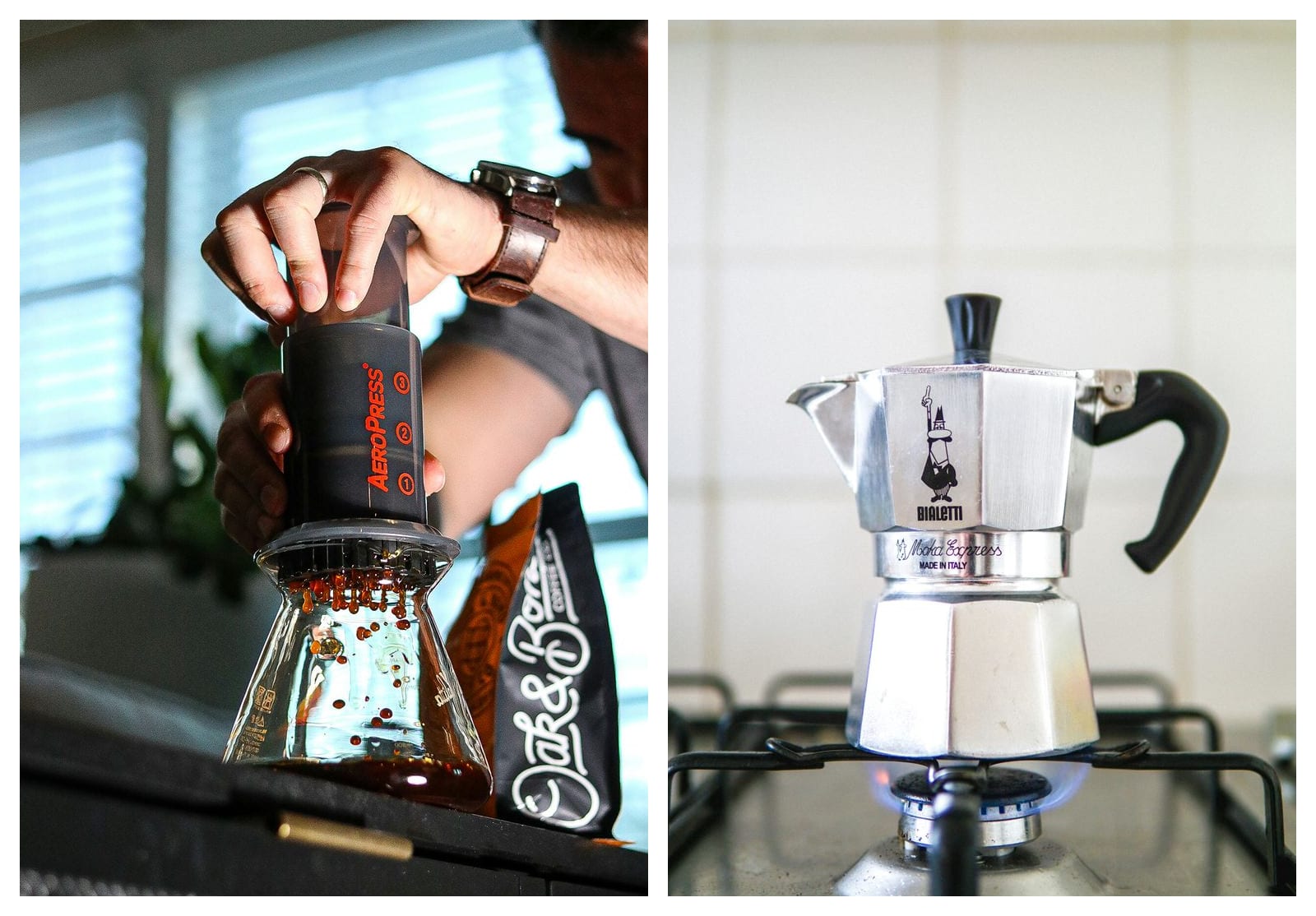
The two ways to a strong cup without an espresso machine: hand pressure through a filter, or steam pressure on a stovetop. · Photos by Oak & Bond Coffee Co., and Elle Hughes on Unsplash
The AeroPress and the Moka Pot are both compact, affordable, and capable of a strong cup, but they make fundamentally different coffee. The Moka Pot forces steam pressure through finely ground coffee on a stovetop: a dense, intense brew that resembles espresso in strength if not in character. The AeroPress uses gentle hand pressure and a paper or metal filter to brew a clean, versatile cup in one to two minutes, with almost no skill floor. Get the Moka Pot if you want that specific bittersweet stovetop cup, you mostly drink coffee with milk, or you grew up with one. Get the AeroPress if you are buying your first compact brewer: it is more forgiving, easier to clean, and it travels. If what you actually want is espresso, neither will get you there; that takes an espresso machine.
My grandmother was Italian, and her coffee came out of the same old moka pot every day. Her kitchen in Brazil was tiny and old, next to a terrace, and when I visited as a kid the whole room smelled of coffee. She is the one who taught me to make moka.
I live in Amsterdam and I still make moka the way she showed me. Keep that in mind while I try to be fair to the AeroPress.
What actually separates these two methods
The AeroPress and the Moka Pot are both sold as compact alternatives to an espresso machine, and both produce a concentrated cup. Beyond that, the comparison breaks down quickly. The mechanism, the filter type, and the cup itself all differ.
A Moka Pot is a stovetop brewer that Alfonso Bialetti began marketing as the Moka Express in 1933 (Wikipedia, "Moka pot"). It has three chambers: water at the bottom, a filter basket of finely ground coffee in the middle, and a collection chamber on top. When you heat the pot on a stovetop, the water boils and steam pressure, typically 1 to 2 bar, forces hot water upward through the coffee grounds and into the top chamber. The result is a small volume of dense, intense coffee with significant body, low acidity, and a flavor profile shaped heavily by the metal filter: oils pass through freely, fines do not.
An AeroPress is a manual brewer invented by Alan Adler, a Stanford engineering lecturer, and debuted at Seattle's Coffee Fest in November 2005 (AeroPress, "About"). It consists of a cylindrical plastic brew chamber and a plunger. You add coffee and hot water, steep briefly, then press the plunger to force the brew through a paper or metal filter into a cup. The pressure involved is gentle, generated entirely by hand, and far lower than a Moka Pot or an espresso machine. What the AeroPress offers is control: you can adjust steep time, water temperature, grind size, and filter type across a wide range, and each combination produces a meaningfully different cup.
The filter is where the cups diverge most. The Moka Pot's metal basket lets oils through; the AeroPress with a paper filter catches them. The Moka Pot's pressure extracts at a fixed rate determined by the heat source; the AeroPress extraction rate is controlled by how hard and how fast you press. If the underlying mechanism is what you are after, what coffee extraction actually is explains what the water is pulling out in both cases.
When AeroPress earns its place
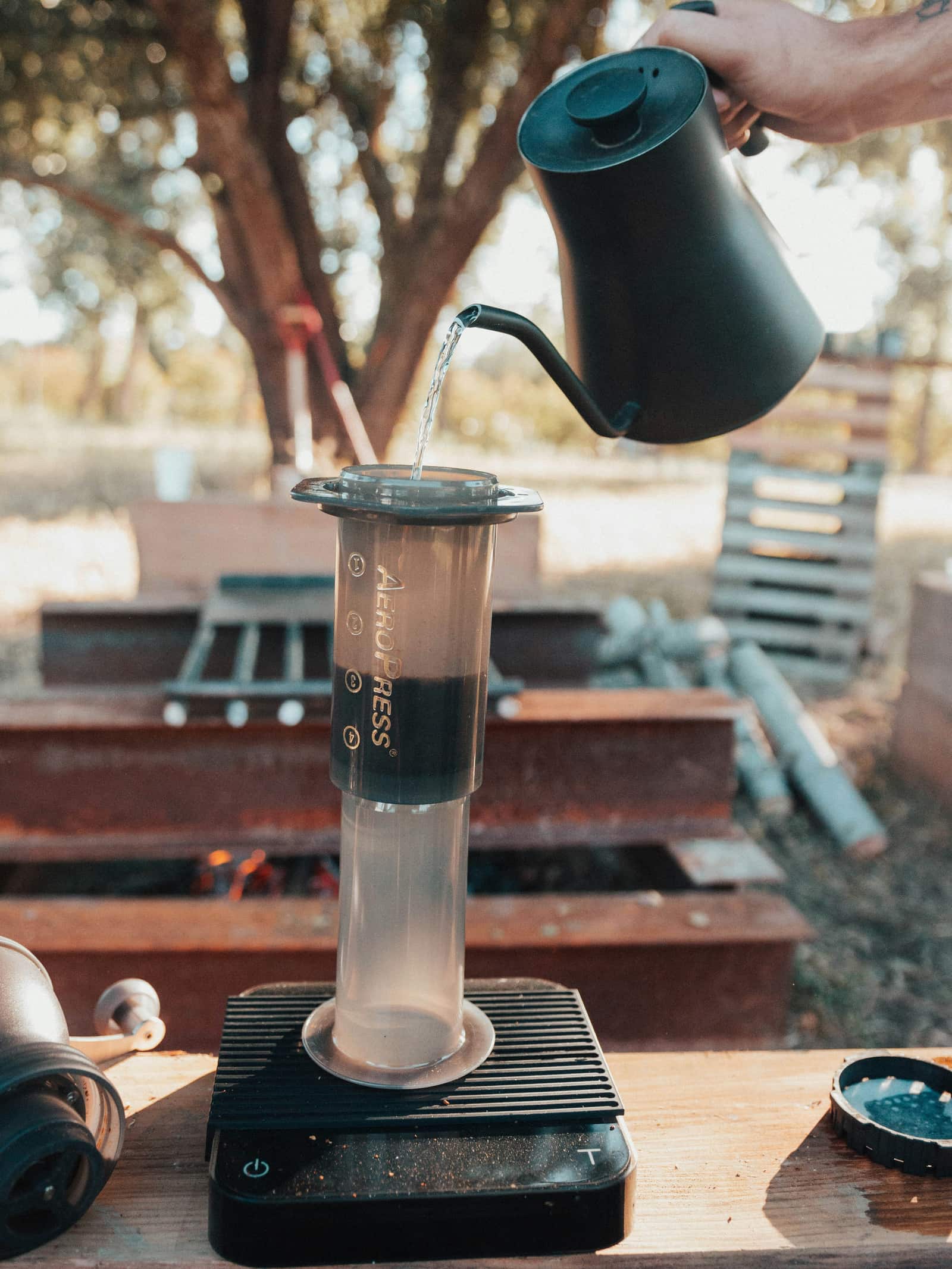
The AeroPress earns its reputation on three qualities: forgiveness, versatility, and portability.
On forgiveness: it is the most error-tolerant brewer in common use. A grind that is slightly off, water that is a few degrees cooler than intended, or a steep time that runs long all produce a cup that is still drinkable, sometimes very good. The pressure and short contact time buffer the kind of mistakes that would ruin a pour over or produce a harsh Moka Pot brew. This is why it is such a common first recommendation for people who want to improve their coffee without spending the time a pour over demands.
On versatility: the AeroPress can produce several distinct styles of coffee depending on recipe. With a fine grind and a short, hard press, it produces a small, concentrated brew you can dilute with hot water to approximate a long black or Americano. Switch to a medium grind, a longer steep, and a metal filter, and it edges toward French press territory: heavier body, more oils in the cup. With a paper filter and a medium-fine grind, it produces a clean cup closer to pour over. One brewer covers a wide range of outputs, which is why it has a devoted community of recipe developers and its own annual world championship: the 2023 edition drew more than 5,000 competitors across 178 events (AeroPress, "About"). Even inventor Alan Adler sounds bemused by what the community does with it: "brewing upside down is a big thing," he told Priceonomics (Priceonomics, "The Invention of the AeroPress").
On portability: the AeroPress is plastic, light, and nearly unbreakable. It fits in a backpack, does not need a power source, and cleans up in one motion: the spent grounds compress into a dry puck that pops directly into the bin, and the plunger rinses clean in seconds. For travel, office brewing, or camping, nothing else in this price range competes.
There is no one canonical AeroPress recipe: published ones disagree on steep time, temperature, and ratio, and the brewer handles all of them. Our AeroPress house recipe is the starting point we recommend: 15g (0.53oz) of coffee, 225ml (7.6 fl oz) of water at 85°C (185°F), medium-fine grind, a 1:15 ratio, tuned for a clean, body-forward cup that forgives bean choice.
The catch is volume. A single AeroPress brew makes one cup, sometimes two if you dilute the concentrate. For a household that needs three or four cups in the morning, you are pressing in sequence: fast, but not batch-capable the way a Moka Pot or a drip machine is.
When Moka Pot is the right call
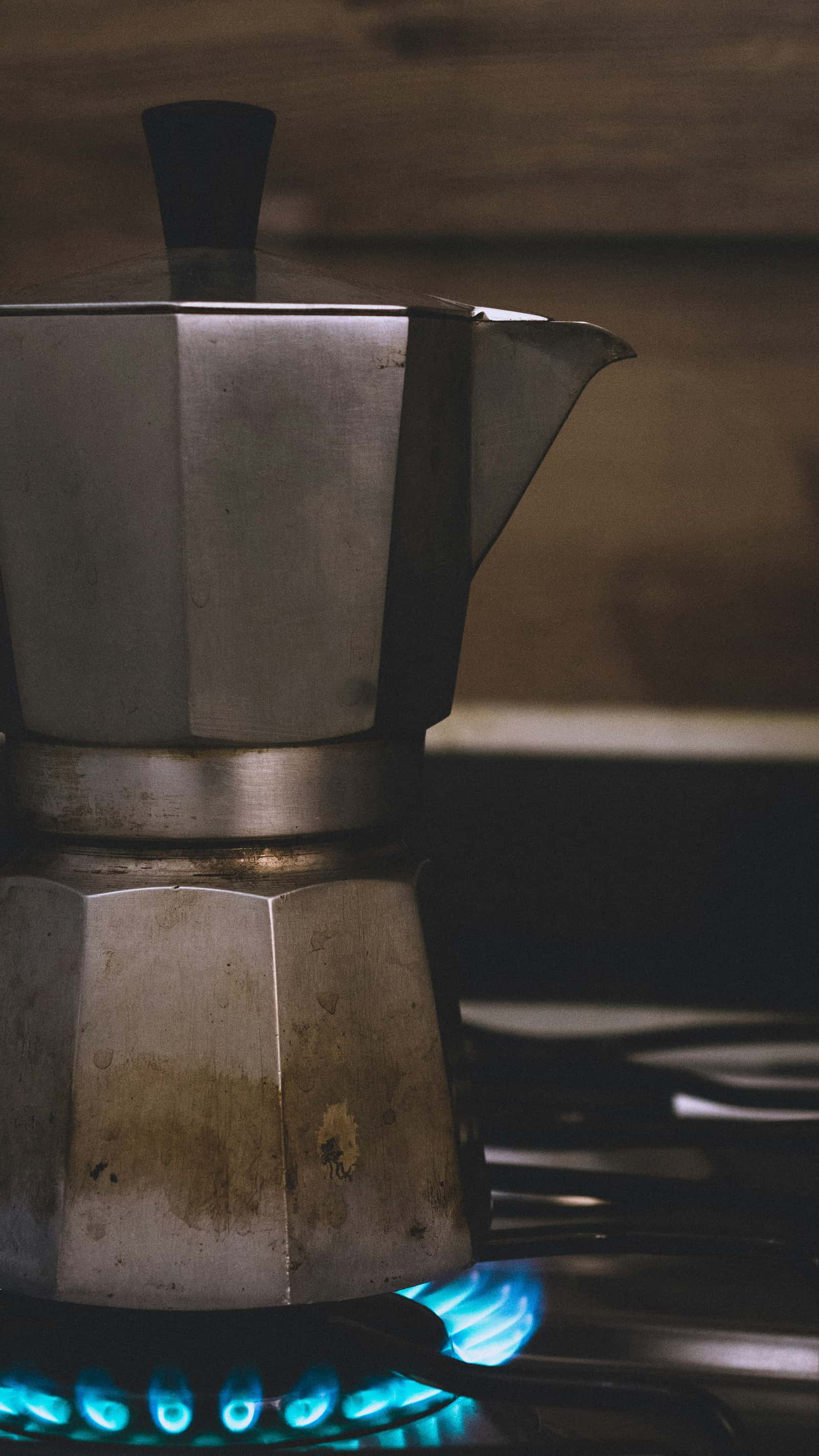
The Moka Pot has been a fixture in Italian and Latin American kitchens for nearly a century. The original Bialetti Moka Express design, eight-sided with the mustachioed mascot, is still manufactured today, and a 2010 study calculated that 90% of Italian families own a Bialetti moka pot (Wikipedia, "Bialetti"). The Moka Pot produces a cup that no other affordable home brewer replicates: dense, full-bodied, intensely flavored, with a natural crema-like foam on top when brewed correctly, and a bittersweet character that sits between filter coffee and espresso.
The Moka Pot suits dark and medium-dark roasts better than lighter ones. The pressure extraction at high temperature tends to amplify bitter and sharp notes in lighter roasts, while it rounds and deepens the same notes in darker ones. A well-roasted dark or dark-medium blend out of a Moka Pot tastes rich, warm, and substantial in a way that pairs naturally with milk.
The standard recipe is straightforward but unforgiving. Fill the bottom chamber to just below the safety valve, using hot water rather than cold: it cuts the metallic taste and shortens the time the pot spends on the flame. "If you fill water past this level, too much pressure will build up," warns barista Nadia Bachur in Perfect Daily Grind's moka pot guide (Perfect Daily Grind, "How To Brew Great Coffee With A Moka Pot"). Fill the filter basket with finely ground coffee, level, and do not tamp. Screw the top and bottom chambers together firmly. Place on low to medium heat, lid open, until the coffee begins to flow into the upper chamber. Pull the pot off the heat at the first gurgle, before the last sputtering runs through, which is the harsh, burnt part that ruins the cup. The whole process takes 4 to 6 minutes. Our Moka Pot house recipe runs 18g (0.63oz) of coffee to 160ml (5.4 fl oz) of water, a 1:10 ratio, fine grind, for a concentrated 133ml (4.5 fl oz) in the cup.
The grind is critical. Moka Pot coffee requires a fine grind, finer than drip and closer to espresso, but not as fine as espresso. The wrong grind in either direction produces problems that are hard to correct mid-brew: too fine and the basket clogs and the coffee over-extracts, turning bitter and acrid; too coarse and the water passes through too fast, producing a thin, sour cup. Unlike the AeroPress, there is no steep time to adjust and no pressure variable to soften the mistake.
The honest downside is the learning curve and the cleanup. Getting the heat, the grind, and the timing right takes several brews, and the margin for error is narrower than anything else in this comparison. The pot also requires disassembly and a proper wash after each use: the gasket and filter basket collect oils and grounds that turn rancid if left. Moka Pots are not dishwasher-safe. Some owners develop a strong attachment to the seasoned patina of a well-used pot; others find the maintenance a recurring chore.
How do these methods actually compare side by side
Here is the same information in one table. Prices are US dollars and assume decent gear rather than premium.
| What you are comparing | AeroPress | Moka Pot |
|---|---|---|
| Brew time | 1 to 2 minutes | 4 to 6 minutes |
| Hands-on effort | Low to medium. Forgiving. | Medium. Heat control and timing matter. |
| Cup style | Versatile: clean to full-bodied depending on recipe | Dense, intense, full-bodied, bittersweet |
| Grind | Typically medium to medium-fine | Fine, approaching espresso |
| Best for | Any roast; flexibility; travel; beginners | Dark and medium-dark roasts; traditional stovetop ritual |
| Volume | 1 cup per press | 1 to 6 cups depending on pot size |
| Pressure | Low, hand-generated | Medium, steam-driven (1 to 2 bar) |
| Portability | Very high. Plastic, light, nearly unbreakable. | Low. Aluminum or steel; not sealed for travel. |
| Cleanup | Easiest of any brewer. Puck pops out, rinse plunger. | Annoying. Disassemble, wash all parts, no dishwasher. |
| Sediment in cup | Minimal with paper filter; some with metal | Minimal |
| Entry cost | $35 to $50 | $40 to $60 |
| Recurring cost | Paper filters (optional; metal filter available) | None |
Which should you pick
If you are buying your first compact brewer: Get the AeroPress. The skill floor is lower, the cleanup is faster, and the range of recipes means you can spend weeks experimenting before you land on a style you love. A bad AeroPress cup is drinkable. A bad Moka Pot cup is harsh, and the next one will be too until you figure out whether the heat or the grind was at fault.
If you want to replicate espresso at home: Neither will produce true espresso, which requires around 9 bar of pressure (Wikipedia, "Espresso"). The Moka Pot, at 1 to 2 bar, produces a cup that is stronger and more concentrated than drip but is not espresso in flavor profile. The AeroPress, with a fine grind and a hard press, produces a small, concentrated shot that is closer in spirit to a long espresso, but without the crema or the intensity. If true espresso is the goal, a dedicated machine is the only answer, and how to make espresso at home covers what that actually takes. If "strong coffee" is the goal, both serve well.
If you drink your coffee black: The AeroPress with a paper filter produces a cleaner, more articulate cup that holds up well without milk. The Moka Pot's dense, oily brew is often too bitter or intense to drink straight without a well-chosen dark roast and precise technique. Most Moka Pot drinkers add milk or sugar.
If you add milk to your coffee: Both work, but the Moka Pot was built for this: its concentrated output is the traditional base for a stovetop cappuccino or a cafe con leche. The AeroPress concentrate with steamed milk gets close, with more control over the flavor profile.
If you travel or brew at the office: AeroPress, without hesitation. The Moka Pot requires a stovetop or a compatible induction hob, disassembles into multiple parts, and is not sealed for transport. The AeroPress fits in a laptop bag, needs only a way to boil water, and cleans up in 30 seconds.
If you grew up with a Moka Pot or you want that specific flavor: Get the Moka Pot. The bittersweet, dense cup it produces is a distinct style that the AeroPress does not fully replicate, regardless of recipe. If that cup is what you are looking for, no substitution lands in the same place.
If you use dark roasts and you want a strong morning cup quickly: The Moka Pot suits this better than any other manual brewer, once you have the technique dialed in. A 3-cup Bialetti on medium-low heat yields around 130ml (4.4 fl oz) of concentrate in about five minutes: one strong mug topped up with hot water or milk, or two small cups.
What gear do you actually need
For AeroPress: The brewer itself at $35 to $50 includes enough paper filters for the first several months of daily brewing. A metal filter disc is available separately and eliminates the recurring filter cost while adding more body to the cup. Any kettle works, though a temperature-controlled one helps: AeroPress recipes range from 80°C (176°F) to 96°C (205°F) depending on the style. A digital scale at $15 to $25 is recommended for ratio consistency. A burr grinder matters here as much as for any other method.
For Moka Pot: The pot itself is the main cost: on Bialetti's own store the Moka Express runs $40 to $60 for the common sizes (Bialetti, official store), and street prices at general retailers often come in lower. Bialetti is the most replicated and the most commonly recommended brand. Check your hob: standard aluminum Moka Pots do not work on induction, and induction-compatible stainless versions cost a little more. No recurring consumable cost once you own the pot. A burr grinder is particularly important here because the fine grind required by a Moka Pot is where blade grinder inconsistency causes the most damage: the wide particle spread means some grounds over-extract and some under-extract in the same brew.
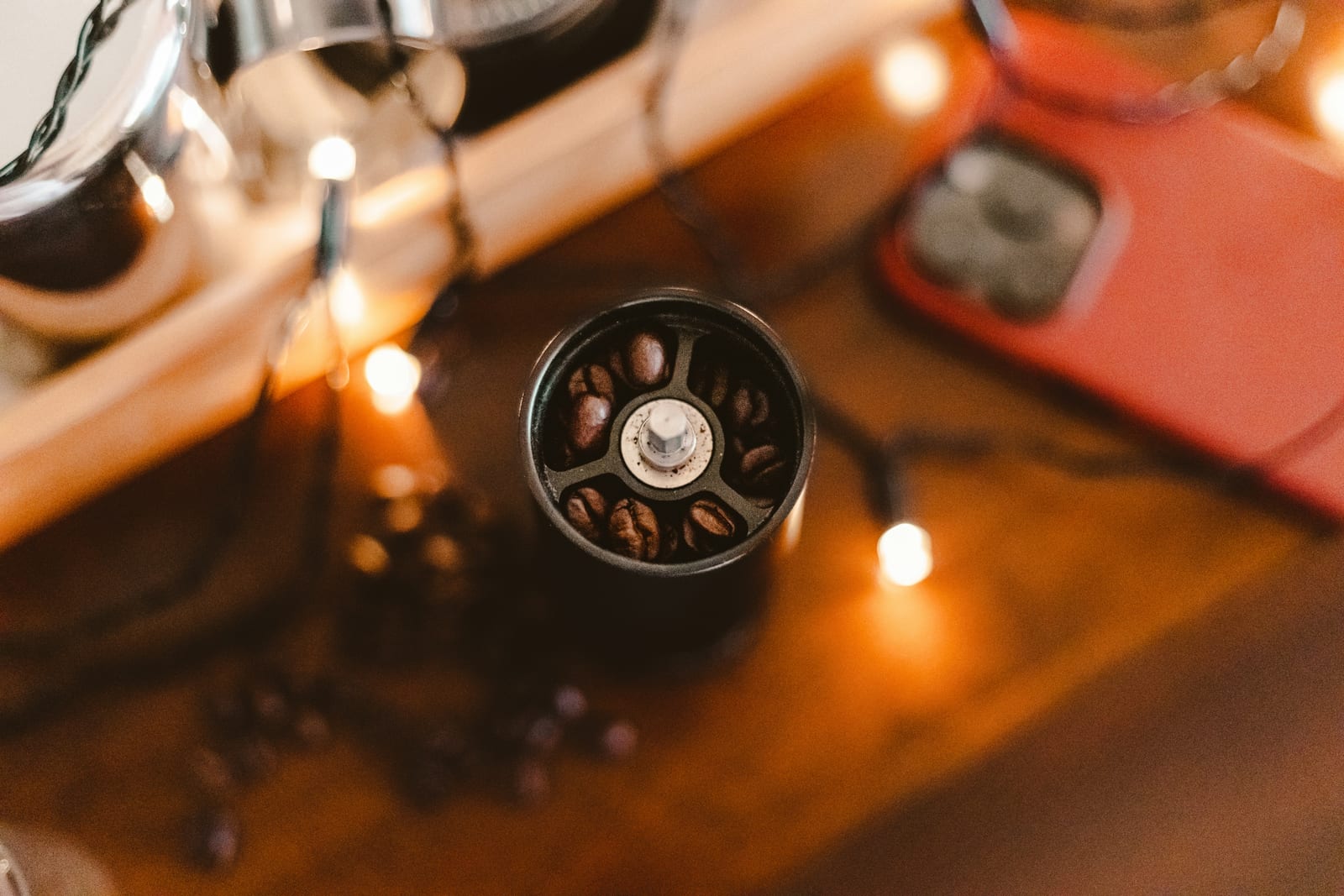
The shared variable that matters most: The grinder, and this pairing shows why more clearly than most. The Moka Pot asks for a fine grind, and fine is where a blade grinder's uneven output does its worst damage: dust that clogs the basket and over-extracts sits next to chunks that under-extract, in the same brew, and no heat adjustment fixes both at once. The AeroPress is more forgiving of an uneven grind, but no brewer can make an inconsistent grind repeatable. A manual burr grinder starts around $40 to $60. An entry-level electric runs $150 to $200. If you are not sure whether yours is holding you back, is your grinder the problem? walks through how to confirm it before you spend anything.
Frequently asked questions
Is AeroPress better than a Moka Pot?
For most beginners and travelers, yes. The AeroPress has a lower skill floor, a wider recipe range, better portability, and easier cleanup. The Moka Pot is better for people who want a specific dense, intense cup style, who add milk to their coffee, or who value the stovetop ritual. Neither is universally better; they produce different cups and suit different habits.
Does a Moka Pot make real espresso?
No. Espresso requires around 9 bar of pressure. A Moka Pot generates 1 to 2 bar, which produces a strong, concentrated brew that shares some qualities with espresso (intensity, body, bittersweet notes) but is a different beverage. The flavor sits closer to espresso than to drip, but the mouthfeel, crema, and extraction profile are distinct: its own style, not a substitute.
Can I use the AeroPress to make espresso-style coffee?
Yes, up to a point. A fine grind, a short steep, and a firm press produce a small, concentrated cup that works as the base for milk drinks. It will not have crema or espresso's texture; whether it satisfies the craving depends on how much those matter to you.
What grind size does a Moka Pot need?
Fine, approaching espresso but not quite as fine. On most adjustable burr grinders, Moka Pot sits one or two steps coarser than espresso. Our house recipes put the Moka Pot and the standard AeroPress at the same fineness, both a step finer than a V60 pour over, so if you already brew AeroPress you are close to the Moka Pot setting rather than far from it. The exact setting depends on your grinder; dial it in one step at a time and taste the result. It matters because grind is the main lever you have over extraction. "Higher extractions are almost always better," as Scott Rao puts it in his piece on rating grinders (Rao, "Using Extraction Levels To Rate Grinders").
How do I stop my Moka Pot coffee from tasting bitter?
The three most common causes are heat that is too high, brewing past the point where the chamber empties (the final spluttering spurts), and a grind that is too fine. Use low to medium heat, pull the pot off the heat at the first gurgle, and try coarsening the grind by one step. If the cup improves, keep going. Starting with hot rather than cold water also shortens the time the coffee spends heating, which helps. Darker roasts also come out less sharply bitter than lighter ones.
Is the AeroPress good for making coffee for two people?
It can be, with a caveat. One standard AeroPress brew makes one large cup, around 200ml (6.8 fl oz) to 250ml (8.5 fl oz). For two cups you press twice, three to four minutes in total. Some recipes produce a concentrated output that you can dilute with hot water and split between two mugs. For households that consistently need two or more cups at once, a Moka Pot in a larger size (4-cup or 6-cup) is more practical.
Where to start
Both brewers have a short ramp-up where the first cups are not the best the method can produce. The AeroPress ramp-up is faster: most people are making a cup they genuinely enjoy within the first week. The Moka Pot takes longer, and its common failure modes (too-high heat, wrong grind, letting the pot run dry) are all fixable once you know what to look for. If your cups come out bitter or flat and you cannot tell which variable is at fault, why your coffee tastes bitter, sour, or weak walks through what each flavor signal means. When you land on a cup you like, the problem becomes making it again tomorrow. That is what iCoffee is for. It keeps the record of what you did and how it tasted, so the next brew starts from what worked instead of from memory.
About the author
Vanessa Simões
Co-founder of iCoffee
Make your next cup count.
iCoffee is the app that helps you brew better coffee at home, every day.
Get the appdownloadKeep reading
AeroPress vs Espresso Machine: Which One Is Right for You?
The AeroPress costs $40. An espresso machine costs $200 to $2,000. Here is what you get for the difference, and which one makes sense for your kitchen.

Pour Over vs Drip Coffee: Is the Upgrade Worth It?
A pour over gives you the temperature, the pour and the grind to adjust. A drip machine gives you a button. Which one suits you, on flavor, effort and cost.
French Press vs Drip Coffee: Which One Should You Use?
Drip machine or French press: the cup, the effort, the cost and the honest trade-offs compared, plus a clear recommendation for each kind of home brewer.
What Is Coffee Extraction? The Science Behind Every Good and Bad Cup
What coffee extraction actually means, the chemistry behind bitter and sour cups, and the four variables that decide whether every brew tastes good or off.