

Pour Over vs Drip Coffee: Is the Upgrade Worth It?
A pour over gives you the temperature, the pour and the grind to adjust. A drip machine gives you a button. Which one suits you, on flavor, effort and cost.

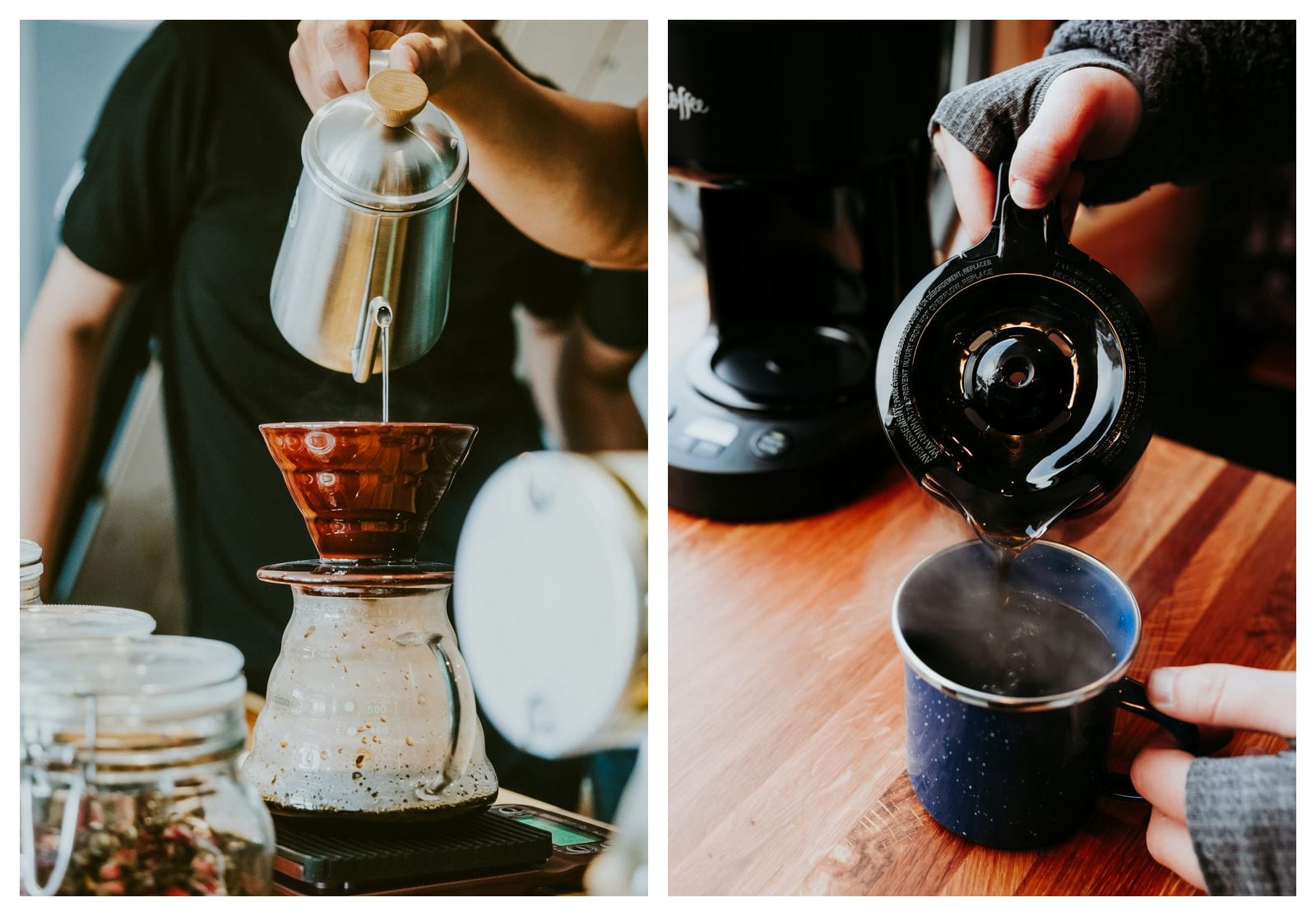
Both of these make filter coffee through paper. On the left you are setting the temperature and the pour. On the right the machine set them years ago. · Photos by Thanh Tran, and Negley Stockman on Unsplash
Both methods pour hot water through ground coffee and a paper filter. A drip machine sets the temperature, the flow rate and the pour pattern for you; with a pour over you set all three yourself, which is either the whole point or the whole problem depending on who you are. The machine wins on volume and on repetition: a 12-cup maker holds about 1800ml (60.9 fl oz), asks nothing but a button, and brews the same on your worst mornings. A pour over takes one cup and your attention, and pays it back in clarity, the origin character of a good bean instead of a competent average. If you brew for three or more people most days, keep the machine and put your money into a better one. If you brew one or two cups from single-origin beans, a $10 dripper is the cheapest real upgrade available to you.
I make a lot of coffee for other people. Friends come over, there's shortbread, and the afternoon runs longer than anyone planned. Six people in the room and one pour over dripper means five of them are waiting.
The rest of the week is the opposite. One cup, nobody waiting on me, and five minutes I'm glad to spend on it. Those two mornings want different things from a brewer, and most of the pour over versus drip argument is written as though only one of them exists.
What actually separates these two methods?
Both methods do the same physical thing. Hot water passes through a bed of ground coffee and a paper filter, and gravity does the rest. You get a clean cup with no sediment and very little oil, which is what separates them from a French press (French press vs drip covers that other fork).
What differs is who sets three things: the water temperature, the rate the water arrives, and where it lands on the coffee.
A drip machine settles all three at the factory. The heating element runs to whatever the design calls for, and the pump pushes water through the spray head at a fixed rate. The spray head then wets the bed in one pattern, whatever that pattern happens to be. You get the same result every morning, and for a lot of mornings that is exactly what you want.
A pour over puts all three under your control. You heat water to the number you want, usually 90°C (194°F) to 96°C (205°F) for filter roasts. You pour in slow circles from a gooseneck kettle, so you decide where the water lands and how fast it drains. You start with a bloom, a small pour of about twice the coffee's weight that wets the grounds and lets the trapped carbon dioxide out before the real pour begins. If the word extraction is carrying a lot of weight in that paragraph, what coffee extraction actually is explains what the water is pulling out of the grounds and why evenness matters so much.
Here's the part I got wrong for years. Everyone says cheap drip machines brew too cool, below the band the Specialty Coffee Association asks certified home brewers to hit, and that this is why the coffee tastes flat. The first half is true; the conclusion people draw from it is not. Mackenzie Batali, William Ristenpart and Jean-Xavier Guinard brewed drip coffee at 87°C (189°F), 90°C (194°F) and 93°C (199°F), "adjusting the grind size and overall brew time as necessary to achieve the target TDS and PE". They found the sensory profile was "governed by differences in TDS and PE rather than the brew temperature" (Scientific Reports, 2020). TDS is how strong the coffee is; PE is how much of the ground coffee ended up dissolved in it. So what you taste follows those two, and the brew temperature barely moves it as long as they hold.
Read their method again and you can see what a cheap machine actually costs you. They landed on the same cup at a cooler temperature by moving the grind and the time. A pour over lets you move both, every morning, for free. A $30 drip machine lets you move neither. So the low temperature on its own is not what ruins the cup. It matters because a cheap machine leaves you no way to correct for it.
When drip earns its place
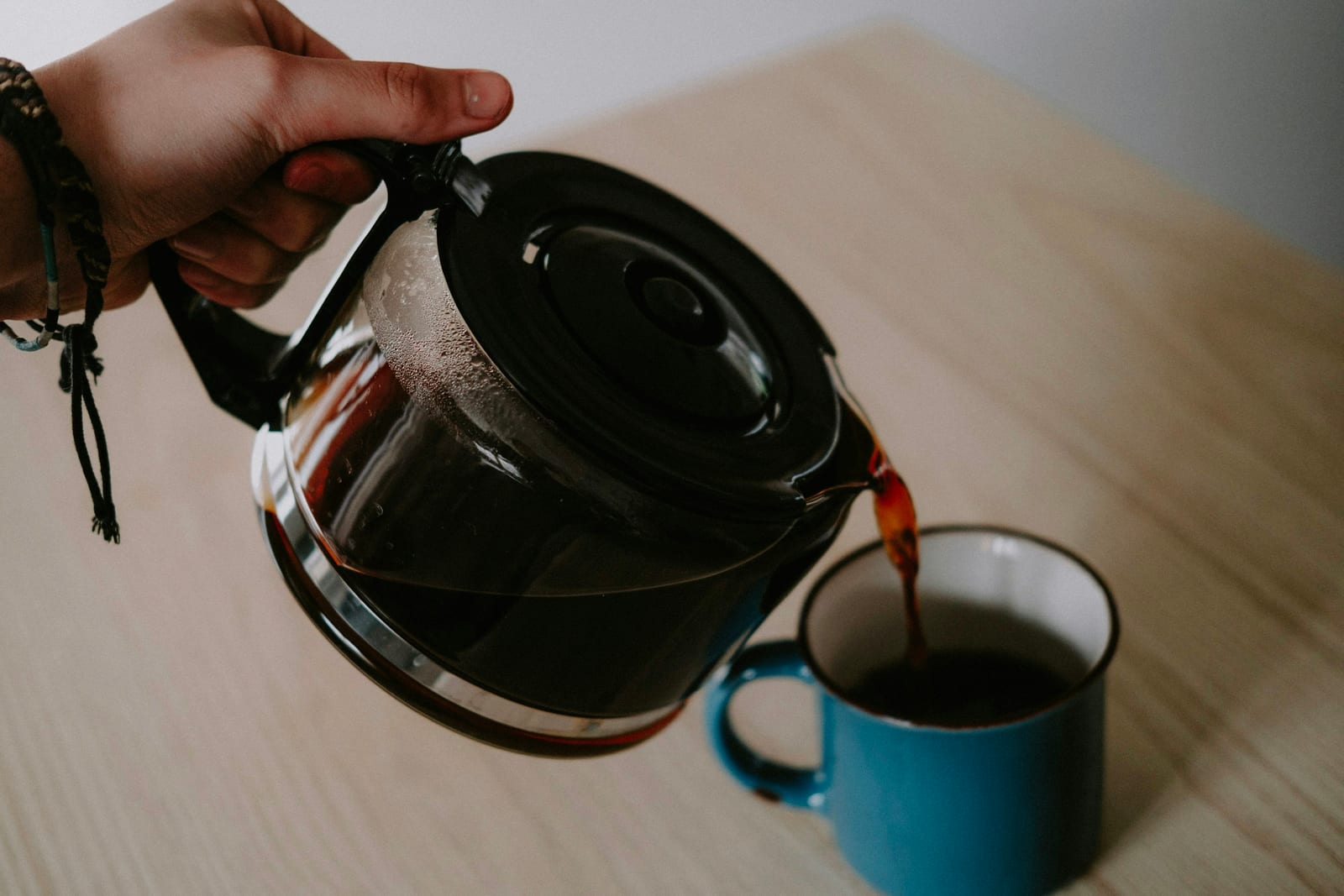
The drip machine has held the kitchen counter for decades because the trade it offers is the right one for most households. You add water, add coffee, press the button and walk away, and there is enough for everybody when you come back.
Volume is the first reason, and the numbers are less impressive than the marketing. A coffee-maker "cup" is five fluid ounces, about 150ml (5.1 fl oz), not eight, and Chemex uses the same measure on its glass (Chemex, six-cup Classic). So a 12-cup machine like the OXO Brew 12-Cup holds 60 ounces, about 1800ml (60.9 fl oz). In mugs that is four. It is still four times what a V60 gives you in one go, and you do not have to stand over it.
The second reason is the mornings when you are barely awake. Pour over rewards steady hands. Pour too fast, start with a grind that drifted finer overnight, or forget to check the kettle, and the coffee comes out different. At 6:30 in the morning, before my first coffee, I am not careful about any of that. The machine runs the same cycle regardless.
It's worth knowing what a certified machine is actually certified for. Under the SCA's equipment standards, a Certified Home Brewer has to get the water at the grounds to 92°C (198°F) inside the first minute, hold it there for the rest of the cycle and never pass 96°C (205°F). Contact time has to land between four and eight minutes, and the carafe has to hold between 80°C (176°F) and 85°C (185°F) for the first half hour after the brew finishes. More than a dozen machines currently carry the mark (SCA certified home equipment), and they run $150 to $350.
A hot plate carries on cooking the coffee it is meant to keep warm, which is why the better machines ship a thermal carafe instead. Paper filters are a small permanent cost, and you notice it the morning you run out.
When pour over is the right call
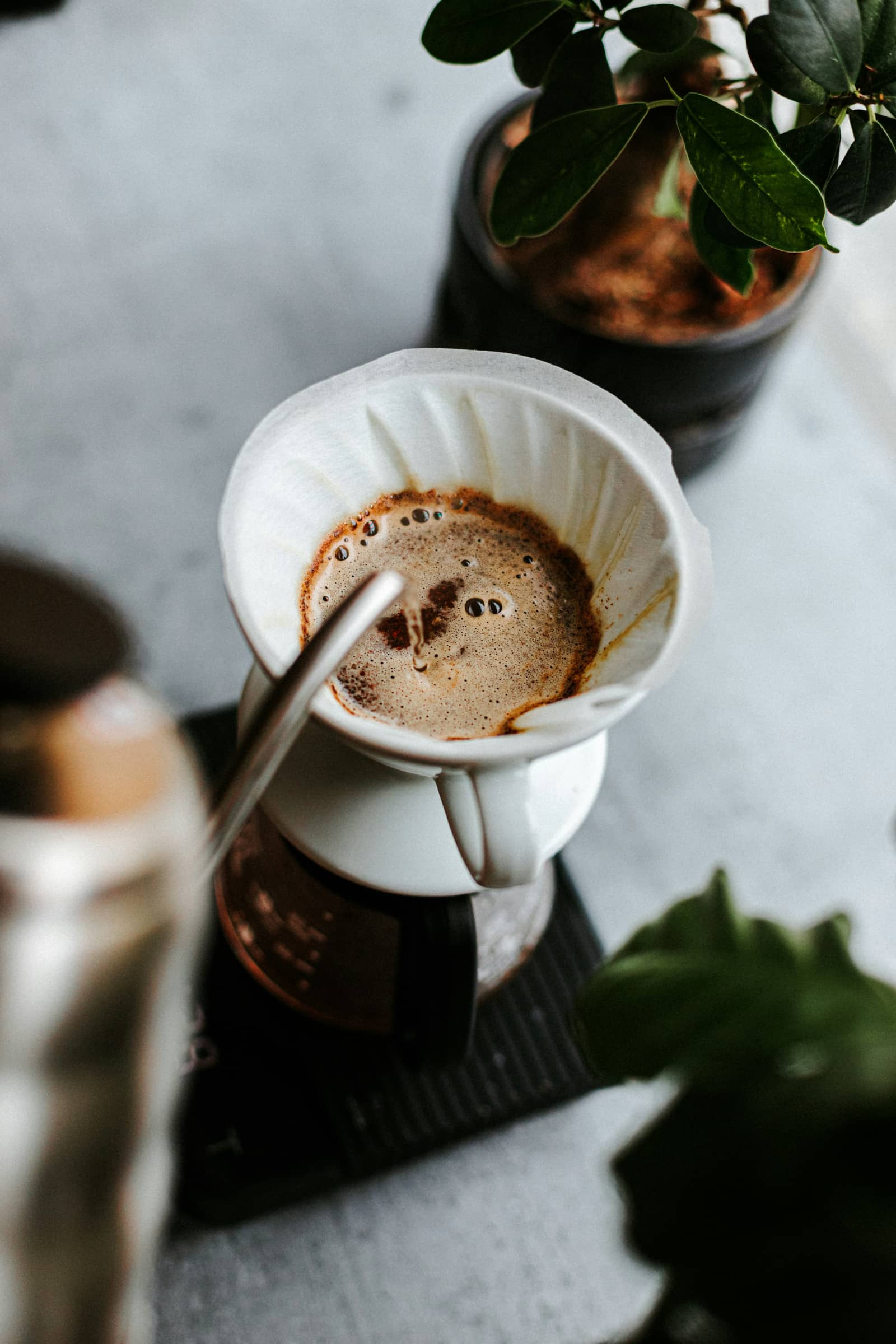
Specialty coffee built its reputation on pour over, and the reason is the paper filter combined with a pour you control.
The filter is doing more than catching grit. Santanatoglia and colleagues compared filter methods on the same coffee and reported that "samples extracted with paper filters (V60 and AeroPress) resulted in higher percentages of caramel-, and flowery-related compounds", where metal-filter brews leaned fruity and roasted (Foods, 2023, full paper). That matches what a good light roast tastes like out of a V60: an Ethiopian natural comes through as citrus and a Kenyan as stone fruit, and the filter is not covering either of them up.
The pour is the other half, and it's where the method gets hard. Water takes the easiest path down through the bed, and where it finds one, extraction goes uneven. Moroney and colleagues modelled the flow through a cone-shaped bed and found that "non-uniform flow in the truncated cone causes significant variation in the local extraction level" (PLoS One, 2019, full paper). Pour into one spot and part of your coffee is over-extracted while the rest never gets properly wet. There's no immersion to even it out and no second pass; the water goes through once.
A working recipe: medium-fine grind, water at 90°C (194°F) to 96°C (205°F), a 1:16 ratio, a 30 to 45 second bloom at twice the coffee weight, and a three minute brew for a single cup from 288ml (9.7 fl oz) of water. Counting the rinse, the grind and the bloom, that is about five minutes from starting to drinking. James Hoffmann's Ultimate V60 Technique lands in roughly the same three-minute brew window.
It does not scale far. A V60 or a small Chemex makes one large cup or two modest ones. The six-cup Chemex holds 30 ounces, about 890ml (30.1 fl oz), which covers two or three mugs if you're willing to run a longer, more careful pour. Past that you're brewing in sequence.
How do these methods actually compare side by side?
Prices below are US dollars, and assume decent gear rather than premium.
| What you are comparing | Pour over | Drip machine |
|---|---|---|
| Brew time | 3 minutes brewing, about 5 start to finish | 5 minutes brewing, about 10 start to finish |
| Hands-on effort | High. Continuous pouring, timing required. | Very low. Fill, press, walk away. |
| Cup style | Clean, light body, high clarity, origin-forward | Clean, light body, less defined |
| Grind | Medium-fine | Medium |
| Best for | Light to medium roasts, single-origin beans | Any roast, volume, convenience |
| Volume per brew | 288ml (9.7 fl oz) to 890ml (30.1 fl oz) | Up to 1800ml (60.9 fl oz) |
| Temperature control | Full. You set it exactly. | Fixed by the machine. |
| Room to correct a bad cup | Grind, pour rate, temperature, time | Grind and dose only |
| Portability | Medium. Dripper packs flat; needs kettle and scale. | None. |
| Cleanup | Medium. Wet filter into bin, rinse dripper. | Easy. Toss filter, rinse basket. |
| Sediment in cup | None | None |
| Entry cost | $50 to $130 for a complete setup | $25 to $350 depending on quality |
Which should you pick
If you already own a cheap drip machine and the coffee disappoints you: buy a $10 plastic V60 and a pack of filters before you spend $200 on a better machine. Same beans, same morning, one cup each way. You will know inside a week whether the problem was the machine or the coffee you were putting in it.
If you brew for three or more people most mornings: keep the machine. Spending on a better machine will do more for you than switching method. Sequencing four pour overs at breakfast is a thing I have done and would not recommend to a friend.
If it's one or two of you: a pour over setup makes sense. At that scale you are not losing any volume, and a full kit costs less than a certified drip machine.
If you buy single-origin light and medium roasts: you're probably not tasting what you paid for. The filter and the control are exactly what those coffees need, and a V60 is the cheapest way to taste them. Our V60 house recipe runs 18g (0.63oz) of coffee and 288ml (9.7 fl oz) of water at 96°C (205°F), medium-fine grind, a 1:16 ratio, built for clarity.
If you want the same cup every morning: the machine wins and it isn't close. A drip machine repeats itself across a week of bad mornings. A pour over will not.
What gear do you actually need
On the pour over side, the dripper is the cheap part. A plastic V60 is $10 and brews as well as the ceramic one, which runs $20 to $50. The Chemex uses a thicker proprietary filter for a softer cup and holds more, at $40 to $55. Then come the two pieces people skip. A gooseneck kettle costs $30 to $50 for a stovetop one, because a normal spout cannot pour slowly enough to control where the water goes. And a scale is $15 to $25, because guessing the ratio by eye gives you a slightly different one every morning. Those are the pieces the $50 to $130 in the table above covers. An electric kettle with temperature control is the one upgrade that takes you past it, at $60 to $150 on its own.
Drip is simpler to cost, because the machine is nearly all of it: $25 at the bottom, $350 at the top, plus filters. A thermal carafe is worth more than a fancier spray head, because it stops the coffee cooking once the brew is finished.
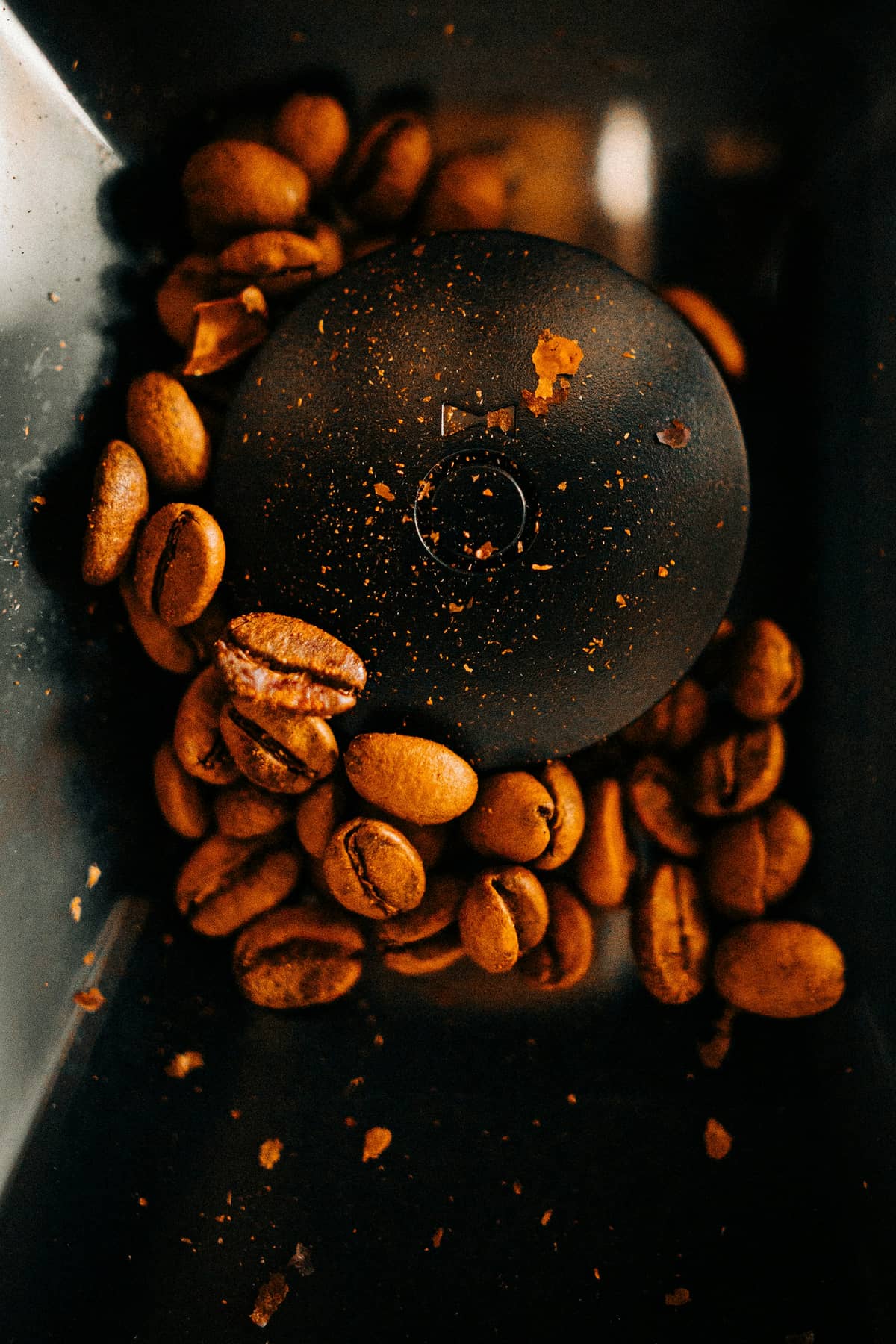
The grinder is the piece that matters on both. Look again at what those UC Davis researchers did to hit the same cup at three different temperatures: they moved the grind size. On either method, grind is the variable you can still move when everything else is fixed. That only works if your grinder produces particles of one size. A blade grinder produces every size at once, so a single cup contains both over-extracted dust and under-extracted chunks, and no setting fixes it. A manual burr grinder starts at $40 to $60 and an entry-level electric at $150 to $200. Spend there before you spend anywhere else, and if you're not sure the grinder is your bottleneck, is your grinder the problem? shows you how to confirm it.
Frequently asked questions
Is pour over coffee better than drip coffee?
It depends on how good your worst attempt is. When the grind, the water and the pour line up, a pour over makes a cleaner and more defined cup than a drip machine at any price. When they don't, it makes something worse than a $40 machine would have produced on its own. Drip is steadier across a household and across bad mornings, and that steadiness is worth a great deal to some people and nothing at all to others.
Why does pour over taste different from drip?
Both use paper, so the cups are in the same family. The difference is precision. You set the temperature, you pour slowly enough to wet the bed evenly, and you give the bloom time to release its carbon dioxide before extraction starts properly. A machine does one fixed version of all three. You're paying for even contact between the water and the coffee, and most spray heads don't manage it.
Do I need a gooseneck kettle for pour over?
Yes, in practice. You can brew a technically functional cup with a normal kettle, but a wide spout dumps water faster than the bed can absorb it, and you lose control of exactly the variable the method exists to give you. It's also one of the cheaper pieces of the kit.
Does pour over take longer than drip?
By total elapsed time, no. A drip cycle takes about ten minutes start to finish, and a single pour over about five, of which three is the brew itself. By time you spend standing there, pour over takes all of it and drip takes about twenty seconds.
Can I make pour over coffee for multiple people?
Up to a point. A V60 makes one large cup from 288ml (9.7 fl oz) of water. A six-cup Chemex holds 30 ounces, about 890ml (30.1 fl oz), which is two or three mugs from one longer pour sequence. Beyond that you brew in sequence, which takes about five minutes a round and means somebody drinks their coffee cold while you finish.
What grind size should I use for pour over?
Medium-fine: finer than table salt, coarser than powdered sugar. Your grinder's numbers won't match anyone else's, so use the brew time instead. If it runs past 3:30 and tastes bitter, go coarser. If it drains before 2:30 and tastes thin or sour, go finer. Change one thing at a time.
Where to start
Don't decide this from an article, mine included. Buy the $10 dripper and a bag of the coffee you already drink, and brew one cup each way on the same morning from the same beans. That is about the price of two flat whites.
Write down what you did on both: the grind setting, the weights, the water temperature, the time, and what the cup tasted like. Almost everyone makes one excellent cup early on, fails to record it, and can't find it again. If the results are confusing and you can't tell which variable to move, why your coffee tastes bitter, sour, or weak tells you what each flavor is pointing at. If you'd rather not keep a notebook, that's why we built iCoffee. It remembers all your brews, and when a cup comes out wrong it tells you exactly what to change.
Three or four brews in, you'll know which of these belongs on your counter, or whether you want both.
About the author
Taissa Conde
Co-founder of iCoffee
Make your next cup count.
iCoffee is the app that helps you brew better coffee at home, every day.
Get the appdownloadKeep reading
AeroPress vs Espresso Machine: Which One Is Right for You?
The AeroPress costs $40. An espresso machine costs $200 to $2,000. Here is what you get for the difference, and which one makes sense for your kitchen.
AeroPress vs Moka Pot: Which One Should You Buy?
Two compact brewers, two very different cups. What separates the AeroPress and the Moka Pot on flavor, effort, cost, and who each one is actually built for.

French Press vs Drip Coffee: Which One Should You Use?
Drip machine or French press: the cup, the effort, the cost and the honest trade-offs compared, plus a clear recommendation for each kind of home brewer.
What Is Coffee Extraction? The Science Behind Every Good and Bad Cup
What coffee extraction actually means, the chemistry behind bitter and sour cups, and the four variables that decide whether every brew tastes good or off.